


130 years of hurt never stopped us dreaming

India (285 all out) lead England (21/1) by 264 runs
The home of cricket finally hosts a women’s test.
Former players from the last 50 years honoured at Lord’s
Smriti Mandhana shines for India, but just misses out on the honours board
Ecclestone takes three wickets to become England’s leading wicket taker
The match is in the balance after day 1
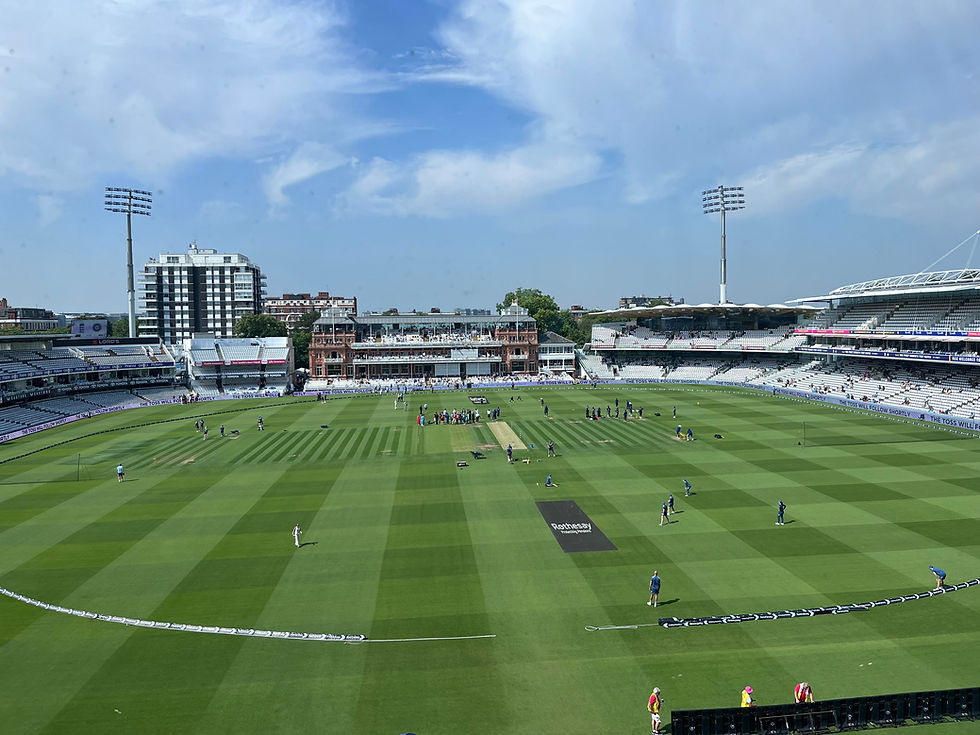
The first men’s test match at Lord’s began on 21st July 1884. In the 142 intervening years, there have been 149 more test at the hallowed home of cricket, all of which have been men’s tests. For the first 92 of those years, women were not permitted to play at Lord’s at all. When women were allowed to play, in 1976, it was only One Day internationals or T20 games, never a test match.
For the first 115 of those years, women were not allowed to be members of the MCC. It was in 1999 that campaigning by former England captain Rachael Heyhoe Flint succeeded in persuading MCC members to accept women as part of their club.
In 2023, the Independent Commission for Equity in Cricket published a damning report into the state of cricket in England, laying a large slice of responsibility at the door of Lord’s and the MCC, stating that the fact that England’s women had never played a test at Lord’s as “truly appalling”.
Only today, on 10th July 2026, was a historical wrong put right when women were permitted to play test cricket at the historical headquarters of the game for the first time. To mark the occasion, portraits were unveiled in the Long Room before today’s match of women’s cricket legends Belinda Clark, Enid Bakewell, Mary Duggan, Jan Brittin, Myrtle Maclagan and England’s 1993 World Cup winning team.
Before the game an amazing group of women’s cricket pioneers, all former internationals, gathered around the Lord’s bell to begin the game and consign to the history books the antiquated ways of the past.
It would be fair to say that the modern day MCC is keen to atone for what happened in the past and the way that those former players, particularly those who played here in 1976, were treated royally and honoured for their contribution to the game was as touching as it was long overdue.
On the field, England played India in a one-off test match squeezed, rather without context, in between the end of the T20 World Cup and the start of The Hundred. Nat Sciver-Brunt won the toss and, rather surprisingly on a scorching hot day, invited India to bat first. Generally, this risky move can be judged as successful if the bowling team can dismiss the batting team on the first day for fewer than 300 runs.
With India’s star-studded batting line up, led out by Smriti Mandhana and Shafali Verma, this seemed, to this observer, something of a risk too far.
It was not long, however, before England were celebrating. Lauren Filer, who has spent the last month carrying the drinks during the T20 World Cup, got Shafali Verma to chase a wide one, providing a very well-taken catch for Amy Jones. England had struck in the second over, Verma departing for a four-ball duck. Yastika Bhattia followed in the 7th over, playing down the wrong line as the ball from Bell careered into her off stump. Bell’s celebration was muted and weary. It may have only been her fourth over, but she had struggled with her line and been hit around for a number of boundaries already in the innings, almost as if she were continuing from her poor set of three overs in last Sunday’s World Cup final.
Now with the majestic Mandhana and the spirited Jemimah Rodrigues at the crease, India accelerated as the boundaries flowed and the batters scampered between the wickets, bringing up India’s 100 in the 19th over. Carrying on at this rate would have seen India hit over 500 runs in the day. However, thankfully for England, the rate reduced considerably following Rodrigues’ dismissal for 35 from 38 balls, dragging a wide ball from Issy Wong back onto her own stumps. Mandhana, who had reached her 50 from a run a ball, slowed down considerably as she was joined by the more cautious Harmanpreet Kaur. Together these two nudged and nurdled another 89 runs from 26 overs spanning the lunch interval.
This attritional cricket was sapping the energy of England’s bowlers and there was a danger that these two batters would take the game away from England if the partnership was not broken soon. England tried a variety of bowling strategies, including something close to bodyline, with Lauren Filer bowling leg side balls to batters with a leg slip and long leg in place. Finally, it was the much-maligned Amy Jones standing up to the stumps to Issy Wong who made the breakthrough, taking a brilliant, instinctive catch as Mandhana flashed at one outside the off stump.
The Indian batting was further breeched by the arrival of Mady Villiers, who dismissed Hamanpreet Kaur the over before tea with a ball that gripped and launched itself spectacularly through Harman’s gate before hitting middle stump. As an off spinner making a test début at Lord’s it was just about the most perfect moment for Villiers.
At tea, therefore, the game stood at a crossroads. With India 202/5, and with both Harmanpreet and Smriti back in the pavilion, could England rattle through the remaining India batters during the next 10-12 overs, dismiss India for under 250, and then go some way to reducing the deficit before the end of the day by hitting some quick runs of their own? The answer was “no” and mainly because of the stubborn resistance of one of the most stubbornly resistant cricketers one is every likely to meet: Deepti Sharma.
Alongside Richa Ghosh and then Sneh Rana, 72 runs were added in just over an hour after tea. By the time Deepti was dismissed, lofting a drive to extra cover from the bowling of Sophie Ecclestone for 57 from 87 balls, India were looking in a much healthier position. Ecclestone, who had bowled 20 fruitless overs whilst watching all the other bowlers pick up wickets, suddenly mopped up the tail and ended up with figures of 3/58, the best in the England team. Her first wicket, that of Sayali Satghare, meant that she overtook Katherine Sciver-Brunt as England’s leading wicket taker across all formats, a remarkable achievement at the age of 27, with many years of international cricket ahead of her.
So, India closed on 285 all out, leaving England’s openers the tricky task of batting out the final 11 overs of the day as the shadows lengthened and the scorch of the afternoon sun faded into the suffocating fug of early evening.
Tammy Beaumont, playing her final match for England, departed early, lbw to Kranti Gaud, and she could have been followed by Heather Knight, also struck on the pad, but given not out. India declined to review a decision which would have seen her gone. We will see if Knight makes them pay for that decision on Saturday when England will recommence on 21/1.


Comments