


Netherlands cricket is flourishing despite, not because of the ICC

Emerging Nations Trophy 2026
Netherlands emerging from 2026 a stronger and more resilient unit
Pakistan and Bangladesh defeated by European minnows
One super six win could see the Oranje qualify for the final
On 27th June this year at Bristol, Polly and I watched what we thought would be the defining moment in the history of women’s cricket in the Netherlands. Having restricted Pakistan to 126/6 from their 20 overs, a first World Cup Finals win was within their grasp. You can hear our excitement here in the recording we made at the half way point of that match.
The Netherlands’ innings started well: they were 54/2 after 10 overs with Sterre Kalis and Babette de Leede at the crease. And then came the collapse. As victory loomed into view, the pressure proved too much for them. The Netherlands were bowled out for 89 and Pakistan won by 37 runs.
On the same recording, you can later hear our deflation and disappointment as we sat in the car, parked in a Bristol side street and ruefully speculated about what might have been, picking over the “what ifs” and “if onlys” of a day when the full member nation asserted its dominance over the associate nation in orange.
It must have been a case of “déjà vu” for Babette de Leede’s team on Sunday at the Seven Districts Ground, Ajman, UAE, 141 days after that Bristol defeat. Pakistan once again hit 126 against the Netherlands in the Emerging Nations Trophy. Could the Oranje keep their nerve this time and record a win against Pakistan? The answer was an emphatic “yes”.
Heather Siegers, Babette de Leede and Sterre Kalis led with the bat as the side from the Low Countries reached new heights by thrashing Pakistan by 8 wickets with more than 5 overs remaining. It is no exaggeration to say that the experience of competing in that World Cup, although it is a tournament in which they won no matches, has transformed the fortunes of this team.
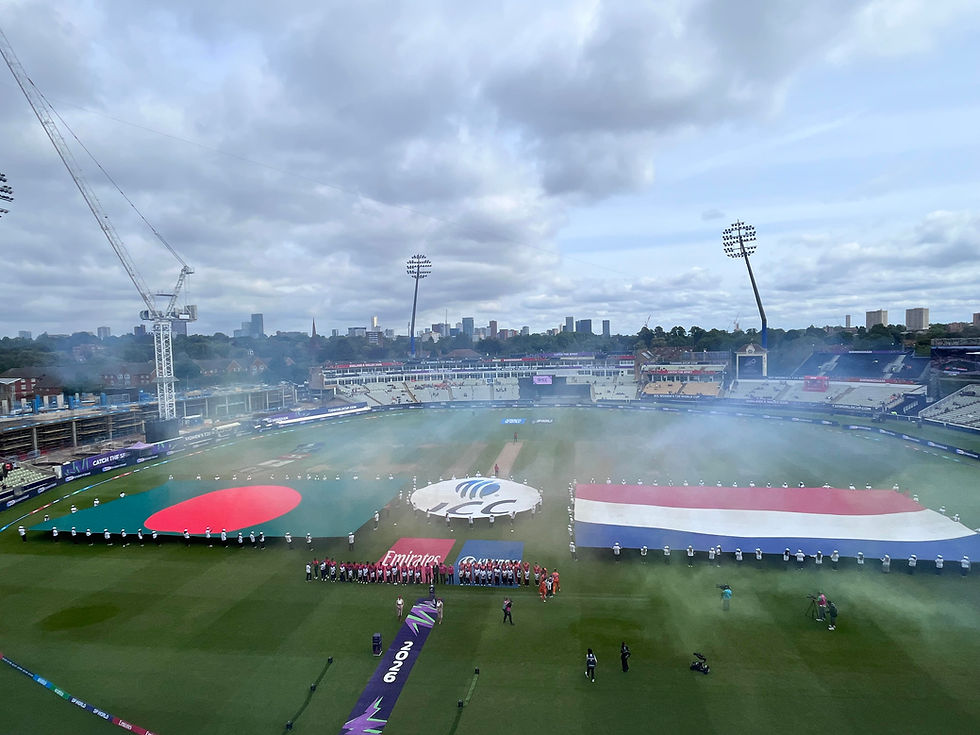
To emphasise this further, having defeated Pakistan on Sunday, the Netherlands on Monday faced another of the teams who had vanquished them in June. Bangladesh had beaten them by 6 wickets with 5 balls to spare in the World Cup at Edgbaston on 14th June. On that day, the Netherlands had batted well to accumulate 139/8, but a pugnacious half century by Juairiya Ferdous had taken the game away from them. It was as close as the team in orange came to victory in the whole tournament.
In the Emerging Nations Trophy game at the Karwan Cricket Ground, Bangladesh batted first and posted 129/8. Once again, the Netherlands were challenged to chase a get-able score, whilst dealing with an ultra-slow outfield and the wily and feisty Bangladesh team, who certainly know how to apply pressure by restricting batters with accurate slow bowling and brilliant fielding.
At one point in the chase, needing 9 runs per over from the final 6 overs, having lost 5 wickets, having only been striking at 5.5 for the first 14 overs, things did not look good for the Netherlands. But some fierce hitting by Sterre Kalis, ably supported by Frederique Overdijk, steered them over the finish line with 2 balls to spare.
Having already beaten Thailand in their opening fixture, the Netherlands have played 3, won 3. They are guaranteed a place in the super sixes and have a huge opportunity to qualify for the final. So what has changed? Why has a team who failed to win in the World Cup suddenly been able to win in the Emerging Nations Trophy?
Firstly, the experience of playing top teams at big cricket venues in England has really helped them. It may be that international cricket has somehow been de-mystified for them. They competed as equals against India, Australia and South Africa as well as against Bangladesh and Pakistan. And despite losing each game, they took away something from each experience.
Individuals like Caroline de Lange, Phebe Molkenboer, Silver Siegers and Iris Zwilling were noticed, praised and talked about by fellow players, commentators and writers. How you perceive yourself must change through that experience. The layers of imposter syndrome must peel away as your achievements are recognised and lauded.
Babette de Leede’s leadership of this team cannot be under-estimated. She took her place alongside Harmanpreet, Sciver-Brunt, Wolvaardt and Molineux at that World Cup and at no point looked out of place or overawed in any way. Heather Siegers’ game has reached new levels since she made the decision to “un-retire” this time last year. She has led with bat and ball in the Emerging Nations Trophy and her performances are a big reason why the Netherlands are doing so well.
And then there is Sterre Kalis. She has been the great star of Netherlands cricket for so many years, with so many hopes resting on her performances. She was not at her best during the World Cup. And the Netherlands still performed well. It feels like this has now taken the pressure off Kalis – she is not as indispensable as we thought - and the batter we see in this tournament is one who is performing with freedom and panache as a result, with over 130 runs from 3 innings and yet to be dismissed.
The glass ceiling
Reaching the final of this tournament or, dare we even think it – winning the trophy, will propel the Netherlands towards another level in the World Cricket pyramid. It will not, of course, result in full member status and all the funding and profile that would bring, because the ICC judges full member status on the performance of the men’s team, not of the women’s.
This injustice – which means that Zimbabwe women (a full member nation) get to play ODIs as part of the future tours programme despite being ranked below five associate nations (including the Netherlands) in the T20 international rankings. Which also means that Afghanistan men get to play as a full member nation despite flouting ICC rules (twice) by not having a women’s team owing to political interference in the governance of the game in that country. This injustice will continue to place a very low glass ceiling on teams like the Netherlands, who continue to flourish and improve despite, not because of the ICC’s policies.
It is injustice like this that meant the Netherlands had to quickly arrange three 50 over matches in Scotland in September in order to preserve their own ODI status, a status which would have been lost, alongside £250,000 funding had there been more rain on one of those days.
It is time for the ICC to completely break the link between full member status in the men’s and women’s game and allow teams to be funded and rewarded on their own merit, not on the merit of their men’s team.
The current system underlines the unwritten and unspoken rule of world cricket: World Cricket is a men’s sport in which we generously allow women to participate because that achieves equality.
Unfortunately, this unwritten rule ignores the fact that if you graft on women’s sport as a side hustle of global men’s cricket, you create a baked-in inequality.
One where it is totally acceptable for a full member nation to silence and exclude all women from all sport and still be allowed to play as part of the global game. One where a national governing body can create fake women’s leagues with fake results in order to get ICC funding to give to their men’s team and when this is discovered the consequence is that the vice president of this national governing body gets elected onto the ICC governing board. One where success of female players and female teams on the pitch will always be secondary to the achievements of men.
Netherlands women could have lifted the World Cup trophy at Lords on 5th July and they still would not have been given full member status because their men’s team is deemed not good enough.
So what next for the Netherlands? They will doubtless continue to play joyfully and competitively on a shoestring budget.
They will need to keep developing young players as the demands of amateur sport will keep pulling talent away from the game. They can hope to qualify for more ICC global tournaments, but there are no guarantees. Lifting the emerging nations trophy would be a statement win which may bring opportunities for players in the short term.
In the long term what they need is huge structural and policy changes at the ICC to give them a slightly larger piece of cricket’s big pie.


Comments